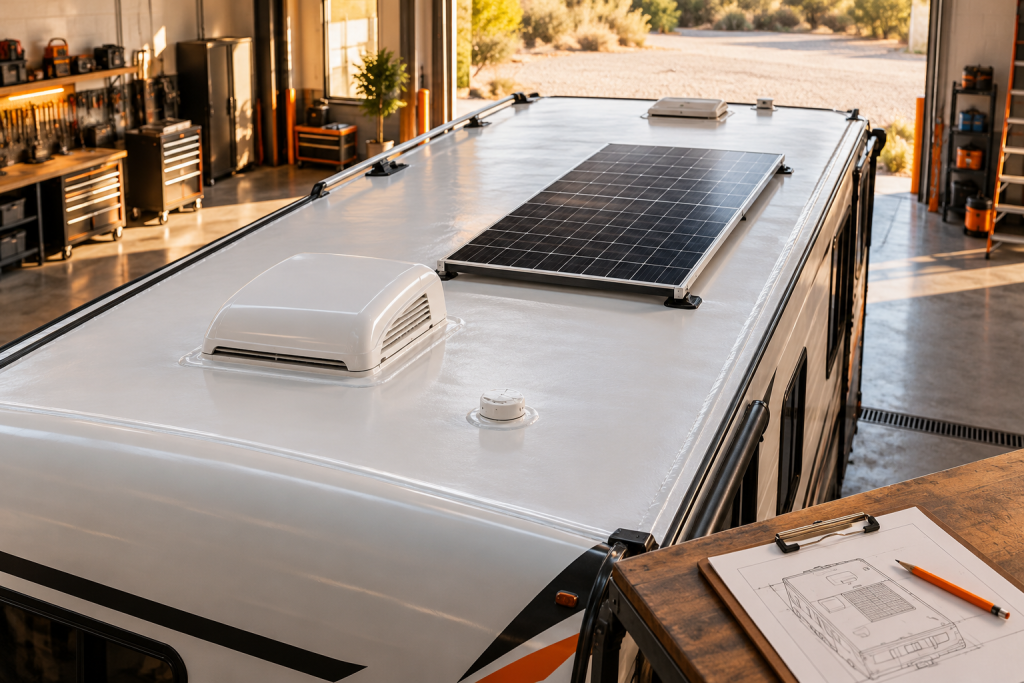
Comparing RV Roof Coating Options: EPDM, TPO, Fiberglass, and Polyurea
In short
Compare EPDM, TPO, fiberglass, and polyurea RV roof coating options. Learn the pros, cons, lifespan, and costs of each material to make the best choice for your recreational vehicle.
On this page
When it comes to protecting your RV roof, the market offers a range of materials and coating options, each with its own set of advantages, limitations, and ideal use cases. Whether you are shopping for a new RV, planning a roof restoration project, or simply researching the best protective coating to extend your current roof’s life, understanding the differences between EPDM, TPO, fiberglass, and polyurea is essential knowledge for any informed RV owner.
EPDM Rubber Roofs
Ethylene propylene diene monomer, or EPDM, has been the dominant RV roofing material for decades. It is a synthetic rubber compound that is lightweight, flexible, and relatively affordable to manufacture and install. Most rubber roofs on mid-range and older RVs are EPDM.
EPDM performs well in moderate climates and is resistant to mild acids and alkaline solutions, making it compatible with most RV roof cleaners. However, EPDM has significant weaknesses. It is highly susceptible to UV degradation, which causes the material to chalk, crack, and become brittle over time. Petroleum-based products — including many common cleaning agents, insect repellents, and tire dressings — can cause EPDM to swell and degrade. The material is also prone to punctures and can develop leaks at seams and around penetration points where caulk tends to crack and separate.
Typical EPDM roof lifespan: 10 to 15 years with proper maintenance. Average replacement cost: $3,000 to $8,000 depending on RV size.
TPO Roofing Systems
Thermoplastic polyolefin, or TPO, is a more modern roofing material that has gained significant market share in the RV industry over the past decade. TPO is a blend of polypropylene and ethylene-propylene rubber, and it offers improved UV resistance compared to EPDM, as well as better resistance to oils and fats — a meaningful advantage for RV owners who frequently cook outdoors or in camp settings where grease and food residues can splash onto the roof.
TPO roofs are typically white or light gray, which provides a modest heat-reflective benefit that can reduce interior temperatures during summer camping. The material is heat-weldable, meaning that seams can be bonded together with hot air rather than relying on adhesives or tapes that can fail over time. This makes TPO seams potentially more durable than EPDM seams when properly installed.
However, TPO has its own limitations. Cheaper formulations can become brittle in cold weather, and the material can degrade faster than higher-grade EPDM if the TPO compound is of poor quality. As with EPDM, penetration points and perimeter edges must still be sealed with compatible caulking and require periodic inspection and resealing.
Typical TPO roof lifespan: 12 to 20 years. Average replacement cost: $4,000 to $10,000 depending on RV size and material grade.
Fiberglass Roofs
Fiberglass roofs are found primarily on higher-end and premium RV models. A fiberglass roof consists of layers of fiberglass mat saturated with a polyester or vinyl ester resin and finished with a gelcoat surface. This construction creates an extremely hard, impact-resistant, and dimensionally stable roofing surface that does not flex, stretch, or shrink with temperature changes the way rubber and TPO materials do.
Fiberglass roofs are highly resistant to UV radiation, require less frequent sealing than rubber roofs, and can be cleaned with a wider range of cleaning products. They also tend to maintain their appearance better over long periods, as the gelcoat surface resists staining and oxidation.
The primary disadvantages of fiberglass roofs are weight, cost, and the complexity of repairs. Fiberglass roofs are significantly heavier than rubber or TPO, which can affect fuel economy and payload capacity. If a fiberglass roof suffers impact damage or develops delamination — where the layers separate from each other — repairs require specialized skills and materials to complete correctly. Improperly repaired fiberglass can allow water infiltration that is difficult to detect until significant internal damage has occurred.
Typical fiberglass roof lifespan: 20 to 30 years or more. Repair and restoration costs vary widely based on the extent of damage.
Polyurea Protective Coatings
Polyurea is not a roof substrate material like the options above, but rather a spray-applied protective coating that can be applied over virtually any existing roof type. It represents a significant advancement in RV roof protection technology and is increasingly being used both for new RV construction and for restoration of aging rubber, TPO, and fiberglass roofs.
Polyurea is a two-component chemical system that, when mixed and sprayed, cures within seconds to form a seamless, monolithic membrane with exceptional physical properties. Unlike traditional coatings that apply as liquids and form individual layers, polyurea creates a single continuous surface with no seams, joints, or gaps — eliminating the primary failure points of conventional roofing systems.
The physical properties of polyurea are impressive across all performance categories. It exhibits tensile strength of 2,000 to 4,000 psi — significantly stronger than EPDM or TPO — combined with elongation of 200 to 400 percent, meaning it can flex and stretch without cracking through the freeze-thaw cycles that degrade traditional materials. It is completely waterproof, highly resistant to UV radiation, and impervious to most chemicals including oils, fuels, and cleaning agents that damage rubber roofs.
A polyurea coating applied over an existing RV roof effectively converts it into a seamless, highly durable waterproofing system. The coating bridges small cracks and gaps in the underlying material, encapsulates existing seams and penetration points, and provides a level of impact resistance that rubber and TPO simply cannot match. Many RV owners who apply a professional polyurea coating extend their roof’s functional life by 10 to 15 additional years.
Making the Right Choice for Your RV
For RV owners with a rubber or TPO roof that is structurally sound but showing signs of age — surface chalking, minor cracking, or areas where sealant is beginning to fail — a polyurea coating restoration is often the most cost-effective option. It is significantly less expensive than full roof replacement, can typically be completed in a single day, and the resulting protected surface will outlast the original roof material beneath it.
For owners of fiberglass-roofed RVs, the priority is typically preserving the existing surface through regular cleaning and inspection, with polyurea coating as an option for areas where the gelcoat has become too damaged or oxidized to restore through polishing alone. For anyone purchasing a new RV, understanding the roof material and its maintenance requirements before buying is a critical part of the evaluation process that is often overlooked in favor of interior features and floor plan considerations.
Free quote
Ready to stop resealing?
Get a seamless polyurea roof from a certified applicator near you. Tell us about your rig in about a minute.