RV Roof Cleaner: What’s Safe for EPDM, TPO and Fiberglass
In short
What roof makers say is safe to clean an RV roof with, what to avoid, how to clean it step by step, and how to handle mold, sap and streaks. Includes a cleaner compatibility checker.
On this page
The safest RV roof cleaner is the one your roof’s membrane maker recommends, and for most roofs that means a mild, non-abrasive cleaner, a medium-bristle brush and a thorough rinse. Dicor tells EPDM owners to use its rubber roof cleaner and to avoid anything with petroleum solvents, harsh abrasives or citrus ingredients. Alpha Systems tells owners of its membranes to use a household cleaner such as dish soap and to keep acetone and petroleum distillates off the roof. Get the roof type right first, because what’s safe on fiberglass can damage a rubber or TPO membrane.
This guide covers which cleaners suit each roof type, a compatibility checker you can run against whatever’s under your sink, a step-by-step cleaning method, how to deal with mold, sap and black streaks, and how often to clean. It sticks to what the roof makers actually publish, because the wrong product can do permanent damage and, on many roofs, void the warranty.
Why the cleaner matters more than the scrubbing
RV roof membranes are thin. Dicor lists its EPDM at 0.035 inches thick and its DiFlex II TPO at 0.027 inches, which is roughly the thickness of a credit card. Solvents that swell or soften the surface, or abrasives that grind it down, take away material the roof can’t spare. Dicor’s own caution is blunt: cleaners or conditioners with petroleum solvents, harsh abrasives or citric ingredients can cause irreparable damage and may void the warranty.
There’s a second reason to be picky. Some cleaners and “protectants” leave a residue, often silicone or oil, that sealants, repair tapes and coatings won’t stick to later. A roof that looks shiny after a cleaning can be a roof that fights you the next time you need to reseal a vent. Our RV roof sealant guide explains why silicone in particular causes so much trouble.
So the order of operations is simple: identify the roof, read what its maker says, then pick a cleaner. If you aren’t sure what you have, our RV roof types guide has a short quiz that helps you narrow it down.
What each roof maker recommends
Here’s what the major roof makers publish, in plain terms. Your owner’s manual and the roof’s own warranty terms take priority over anything general.
| Roof | Recommended | Avoid | Source |
|---|---|---|---|
| Dicor EPDM (rubber) | Dicor Rubber Roof Cleaner with a medium-bristle brush; mineral spirits on a cloth for stubborn spots only | Petroleum solvents, harsh abrasives, citrus cleaners, acetone | Dicor roof care instructions and FAQ |
| Alpha Systems membranes | Non-abrasive household cleaner such as dish soap, medium-bristle brush | Acetone, anything with petroleum distillates, harsh or highly abrasive products | Alpha Systems product care |
| Alpha TPO (AlphaPly, SuperFlex) | Murphy’s Oil Soap with a soft nylon brush or sponge (Alpha’s TPO care sheet) | Solid or granulated cleaners, Armor All and other oil or solvent-based cleaners | Alpha Systems TPO care sheet |
| LaSalle Bristol XTRM-Ply | Products such as Fantastik, Soft Scrub, Windex, Simple Green, Tilex and Murphy’s Oil Soap, per the maker | Any cleaner containing solvents | Family RV Association summary of LaSalle Bristol guidance |
| Fiberglass | Mild soap made for RVs or boats, soft brush | Abrasive powders and pads that scratch gelcoat; silicone-heavy shine products if you’ll ever seal or coat | Check your RV maker’s manual |
| Aluminum | Mild soap and water | Strong mold and bleach cleaners left on the metal (Dicor warns to keep its mold method off aluminum and paint) | Dicor mold and mildew instructions |
| Coated roofs | Whatever the coating maker specifies | Solvents and abrasives not approved by the coating maker | Coating maker’s care guide |
Notice how different the lists are. Alpha’s TPO care sheet suggests Murphy’s Oil Soap, while LaSalle Bristol lists several household sprays and Dicor wants its own product on EPDM. None of them is wrong; they’re written for different membranes. That’s exactly why a generic “best RV roof cleaner” list can steer you wrong.
RV roof cleaner compatibility checker
Pick your roof and the kind of product you’re thinking about using. The checker tells you whether it’s generally safe, needs caution or should be avoided, and why, based on the roof makers’ published care instructions.
Cleaner compatibility checker
Based on roof makers’ published care instructions. Your roof’s own manual and warranty come first.
How to clean an RV roof, step by step
This is Dicor’s EPDM method with a few practical additions. It works on most membranes as long as you swap in the cleaner your roof maker approves.
- Check the weather and the roof. Pick a mild, overcast day or an early morning. Cleaner that dries in hot sun streaks and is harder to rinse. Confirm your roof is walkable, and remember Dicor’s warning that a wet membrane can be extremely slippery.
- Protect the sides. Wet the sidewalls first so runoff doesn’t dry into streaks, and cover anything you don’t want soaked, such as an open roof vent.
- Rinse the whole roof. Use clean water to wash off loose dirt, leaves and grit before you scrub. Scrubbing grit into a membrane is how you scratch it.
- Mix the cleaner. Dicor’s instructions call for its concentrate mixed with 2 or 3 gallons of water for a full roof. Follow the dilution on whatever product you use.
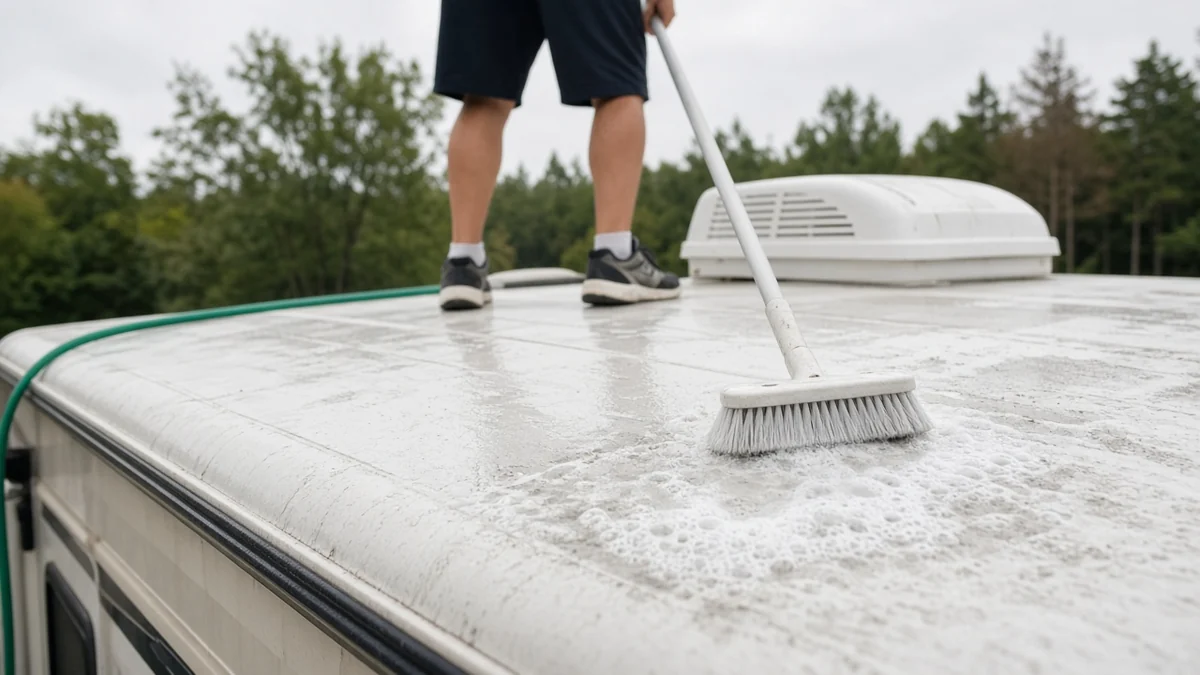
- Scrub in sections. Work a few feet at a time with a medium-bristle brush on a pole, front to back, and rinse each section before it dries.
- Spot-treat stubborn stains. On Dicor EPDM, a cloth dampened with mineral spirits is allowed for stubborn stains, but not over a large area and never left to soak into the membrane. Other roof makers prohibit petroleum distillates entirely, so check first.
- Rinse thoroughly. Residue left on the roof attracts dirt and runs down the sidewalls as streaks. Rinse the roof, then the sides.
- Inspect while you’re up there. A clean roof is the easiest time to spot cracked sealant, lifted edges and small punctures. Use our 10-minute inspection checklist.
- Apply a protectant only if your roof maker approves one. Dicor offers Roof Gard for its EPDM after cleaning. Alpha Systems says its membranes don’t need UV or ozone protectants and that these products can damage them.
Cleaning the sealant around fixtures
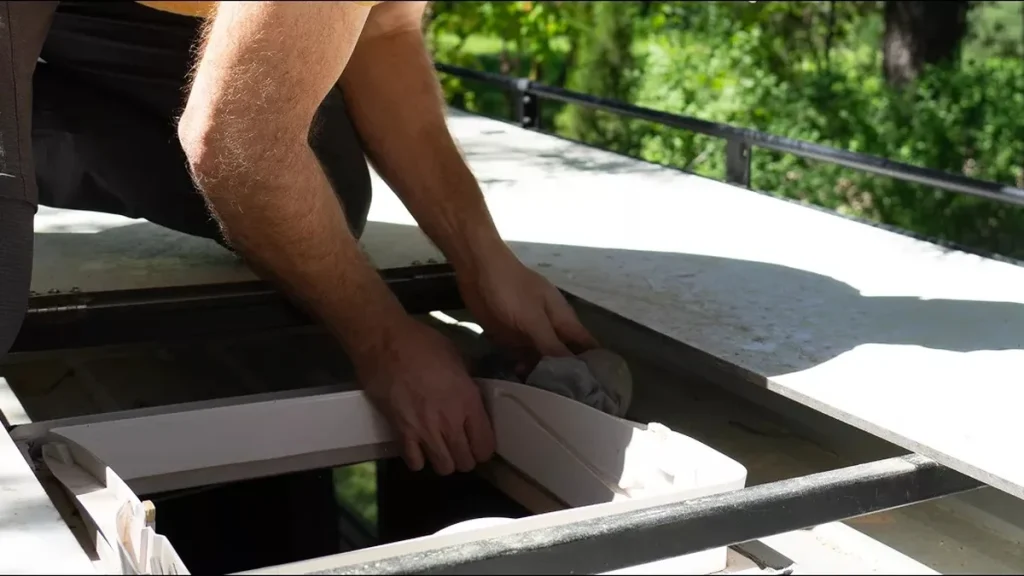
Lap sealant collects dirt along its edges and turns dark. Dicor’s instructions say that if soap and water don’t clean the sealant to your satisfaction, wipe it with a cloth dampened with mineral spirits. Be gentle around old sealant. If it’s cracked or lifting, cleaning is the moment to note it and plan a reseal. Our guides to choosing sealant and RV roof repair cover the next steps.
Mold, mildew, tree sap and black streaks
Mold and mildew
Dicor points out that nothing in EPDM promotes mold; it grows on the dirt and moisture that sit on the roof, especially in shade and humidity. Its published method for EPDM uses a bathroom mold cleaner (Tilex) in small sections, roughly 2 by 2 feet, left on for 3 to 10 minutes, scrubbed with a medium brush, wiped with a damp sponge and rinsed thoroughly. Dicor warns that the cleaner shouldn’t touch painted or aluminum surfaces and should be wiped off right away if it drips down the sidewalls. Check your own roof maker’s guidance before using any mold cleaner on a TPO or PVC membrane.
Tree sap, fruit and bird droppings
Both Dicor and Alpha warn that sap, fruit and environmental fallout left on a roof for long periods can cause stains that won’t come out. The fix is mostly prevention: avoid parking under trees for long stretches and clean more often if you have to. For fresh spots, use your approved cleaner first. Dicor allows mineral spirits on a cloth for stubborn stains on its EPDM, used sparingly.
Black streaks down the sidewalls
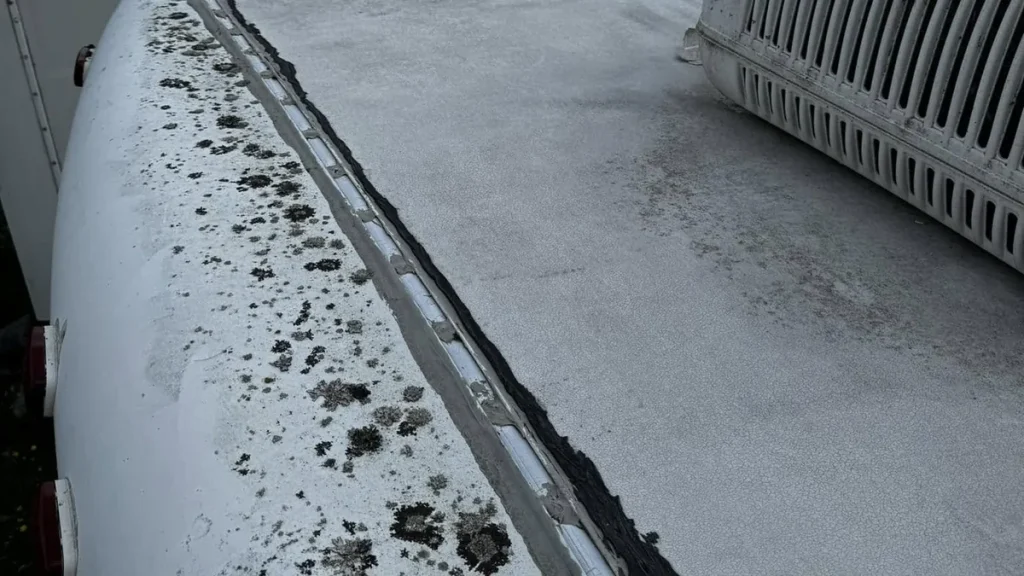
Those streaks usually start on the roof as dirt and oxidation that rain carries over the edge. A clean roof and a good rinse of the sidewalls after every roof wash cut them down a lot. On EPDM, some of the white residue is the membrane itself: Dicor says its EPDM is supposed to oxidize, and may lose around 10 percent of its thickness over a dozen years. Regular cleaning keeps that chalk from building up and running.
How often to clean an RV roof
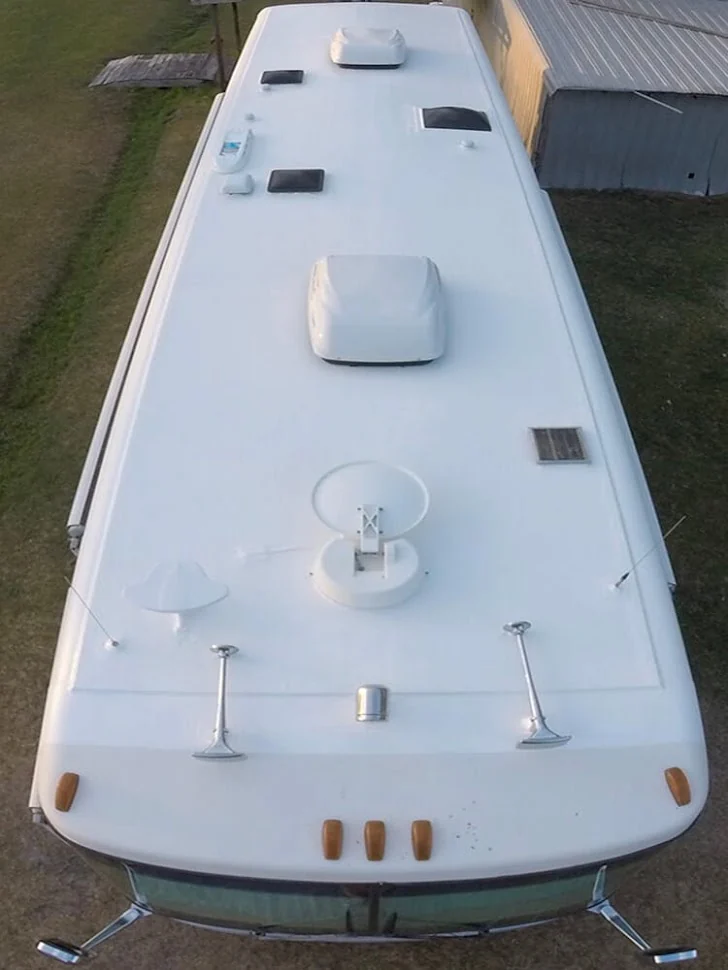
The makers are consistent here. Dicor says to clean its EPDM roofs at least four times a year. Alpha Systems recommends cleaning three to four times a year as the primary maintenance for its membranes. Clean more often if you park under trees, near the coast, in dusty areas, or anywhere fallout sits on the roof.
Line cleanings up with your inspections. Keystone RV recommends inspecting the roof and its sealants at least every 90 days, so a quarterly wash-and-inspect routine covers both. Our RV roof maintenance schedule builds that into a calendar you can download, and the winterization guide covers the clean-before-storage step.
Brushes, pressure washers and other tools
- Brush: Dicor and Alpha both specify a medium-bristle brush; Alpha’s TPO sheet suggests a soft nylon brush or sponge. A telescoping pole keeps you off the most slippery spots.
- Pressure washer: not part of any roof maker’s method we’ve seen. If you use one on low pressure to rinse, keep the nozzle well back and never aim it at seams, sealant or the edges of fixtures, where it can drive water underneath.
- Abrasive pads and powders: leave them in the kitchen. Dicor rules out harsh abrasives and Alpha rules out solid or granulated cleaners.
- Safety: wear shoes with grip, keep the hose out from underfoot and stay off skylights. If your roof isn’t rated for walking, clean from a ladder or scaffold.
Cleaning a coated or sprayed roof
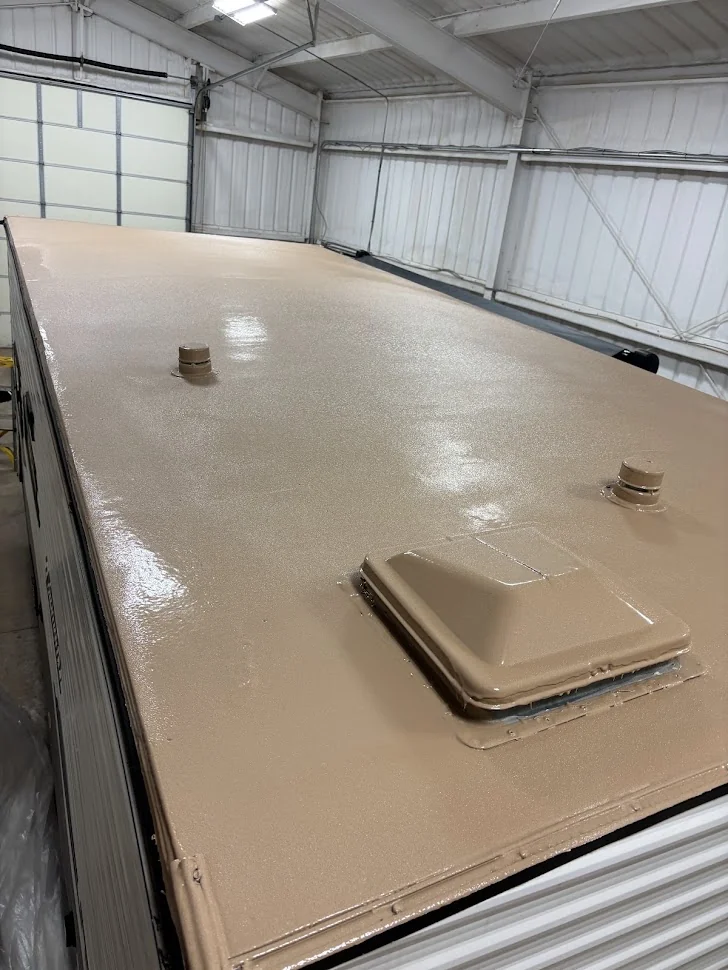
Once a roof is coated, the coating is the surface you’re cleaning, so the coating maker’s instructions apply. Silicone, acrylic and liquid rubber coatings each have their own care notes; see our RV roof coating guide and the coating comparison. For a professionally sprayed polyurea roof, such as one an applicator builds with ArmorThane’s ArmorSeal 100 AL, SureGrip with a topcoat, or ArmorFlex UV, ask the applicator for written care instructions when the job is done. ArmorThane’s RV roof coatings page describes those systems.
Routine washing vs prep for sealant, tape or coating
A routine wash and surface prep are two different jobs, and the rules for one don’t automatically carry over to the other. A routine wash is about removing dirt without harming the membrane, so the gentlest effective cleaner wins. Prep is about getting a surface clean enough for something to bond to it, and the product you’re applying sets the rules.
That’s where the instructions can seem to collide. H.B. Fuller tells you to prep for EternaBond tape with its EternaClean, acetone or lacquer thinner. Dicor says not to use acetone on its EPDM, and Alpha Systems says the same for its membranes. On those roofs, use the tape maker’s own cleaner or whatever the roof maker approves for prep, keep any solvent to a quick wipe on the small area being taped, and never soak the membrane. Coating systems are similar: Dicor’s coatings call for its own cleaner or primer, and Liquid Rubber’s guide has its own prep step. Follow the system you’re applying, check it against your roof maker’s limits, and when they disagree, ask before you start. Our EternaBond tape guide and coating guide walk through prep for each.
A simple roof cleaning kit
| Item | Why |
|---|---|
| The cleaner your roof maker approves | The single biggest factor in avoiding damage |
| Medium-bristle brush on a telescoping pole | The brush type Dicor and Alpha specify; the pole keeps you off slick spots |
| Soft nylon brush or sponge | For TPO, per Alpha’s TPO care sheet, and for gelcoat |
| Hose with a shut-off nozzle | Rinse in sections without flooding the roof |
| Two buckets | One for cleaner, one for rinsing the brush so you’re not spreading grit |
| Clean cotton rags | Spot cleaning and wiping sealant |
| Shoes with grip, and a helper | Wet membranes are slippery; someone on the ground can pass up tools |
Cleaning before storage and after a long trip
Two cleanings matter more than the rest. The first is right before the RV goes into storage. Leaves, pine needles and dirt left on a roof all winter hold moisture against the membrane and sealant, and anything that stains, like sap or bird droppings, has months to set. Clean, rinse, inspect, and fix anything that needs it while the weather still allows sealant to cure. The second is after a long trip, especially one through dusty, coastal or heavily wooded areas, where fallout builds up fast. Both are good moments to look closely at every fixture, since you’re already up there with a clean surface to see.
Cleaning mistakes that damage RV roofs
- Using a citrus degreaser or solvent cleaner on a rubber or TPO membrane.
- Scrubbing with an abrasive cleanser or scouring pad.
- Applying a shine product or protectant your roof maker doesn’t approve, especially silicone-based ones.
- Letting cleaner dry on the roof or sidewalls instead of rinsing as you go.
- Soaking a large area in mineral spirits, or using acetone to clean on a roof whose maker forbids it.
- Skipping the inspection while the roof is clean and you’re already up there.
Cleaning is the best time to inspect. Our guide on how often to reseal an RV roof lists what to look for, and our guide to whether you can walk on an RV roof covers getting up there safely. If the RV sits outdoors between trips, see when RV roof covers help keep it clean.
Frequently asked questions
What can I use to clean my RV rubber roof?
Dicor, which supplies EPDM roofs to many RV makers, recommends its Rubber Roof Cleaner with a medium-bristle brush and a thorough rinse. For stubborn stains it allows a cloth dampened with mineral spirits, used sparingly. It says not to use cleaners with petroleum solvents, harsh abrasives, citrus ingredients or acetone.
Can I use Dawn dish soap on my RV roof?
Alpha Systems recommends a non-abrasive household cleaner such as dish soap for its roof membranes. Dicor specifies its own rubber roof cleaner for its EPDM. Check which membrane you have and follow that maker’s instructions.
Is Simple Green safe for an RV roof?
It depends on the membrane. LaSalle Bristol lists Simple Green among acceptable cleaners for its XTRM-Ply roofs, according to the Family RV Association. Other makers don’t list it, and some prohibit solvent-containing cleaners, so check the label and your roof maker’s guidance.
How often should I clean my RV roof?
Dicor says to clean its EPDM roofs at least four times a year, and Alpha Systems recommends three to four times a year. Clean more often if you park under trees or in dusty or coastal areas.
Should I use a UV protectant on my RV roof?
Only if your roof maker approves one. Dicor offers Roof Gard for its EPDM, applied after cleaning. Alpha Systems says its membranes don’t need UV or ozone protectants and that these products can damage them.
How do I get mold off an RV rubber roof?
Dicor’s published method for its EPDM uses a bathroom mold cleaner (Tilex) in about 2 by 2 foot sections for 3 to 10 minutes, then a scrub, a sponge wipe and a thorough rinse. Keep the cleaner off painted and aluminum surfaces.
Sources
- Dicor Products: EPDM rubber roofing care (cleaning frequency, method, cautions)
- Dicor Products: FAQ (membrane thickness, oxidation, acetone and citrus cleaners)
- Dicor: Cleaning mold and mildew from rubber roofing
- Alpha Systems: Product care (cleaning frequency, dish soap, acetone and petroleum distillates, protectants)
- Alpha Systems: Cleaning and maintaining AlphaPly and SuperFlex TPO
- Family RV Association: RV roof maintenance 101 (LaSalle Bristol cleaner list)
- Keystone RV: Roof assembly maintenance tips (90-day inspections)
Free quote
Ready to stop resealing?
Get a seamless polyurea roof from a certified applicator near you. Tell us about your rig in about a minute.