Can You Walk on an RV Roof? What the Manuals Actually Say
In short
How to tell whether your RV roof is walkable, what the major manuals say, ladder ratings, how to move on a roof safely, and when to stay off.
On this page
You can walk on many RV roofs, but not all of them, and the only reliable answer for yours is your owner’s manual or the manufacturer. Keystone RV’s manual puts it simply: units with a factory-installed ladder have walkable roofs, some units are walkable without a ladder, and others have neither a ladder nor a walkable roof. Even a walkable roof is built for one person doing maintenance, carefully and in dry conditions, not for groups, chairs or storage.
This guide covers how to find out whether your roof is walkable, what the major manuals say, how to get up and move around without damaging the roof or yourself, when to stay off, and how to do roof jobs from a ladder when the roof can’t take your weight. There’s a walkability checker below.
What RV manufacturers say about walking on the roof
| Source | What it says |
|---|---|
| Keystone RV owner’s manual | Units with factory ladders have walkable roofs; some are walkable without a ladder; others are neither. Roofs are for one person doing routine maintenance, not chairs, coolers or multiple people. Ladder capacity 250 pounds. Roofing can be slippery when wet. |
| Jayco towable owner’s manual | Decking under the rubber membrane allows you to walk on the roof, with caution, to do maintenance. Ladder capacity typically 300 pounds, including what you carry; have a second person hold the ladder. |
| Grand Design Imagine owner’s manual | Decking under the rubber membrane allows you to walk on the roof, with caution, to do maintenance. The spec sheet lists a “walk-on roof” with ladder. |
| Winnebago M-Series travel trailer | Model page lists a “fully walkable roof” with a one-piece TPO membrane. |
| Winnebago View motorhome manual | The ladder is for limited roof access; walking or working on the roof should be left to qualified service personnel with proper safety equipment. Ladder capacity 225 pounds. |
| Dicor (roof membrane maker) | Use extreme caution on top of the vehicle; a wet membrane may be extremely slippery. |
The pattern: towable makers whose roofs have plywood or OSB decking under the membrane generally allow careful walking for maintenance. Some motorhome makers are more cautious and steer owners to a service shop. And no one treats a roof as a deck.
How to tell if your RV roof is walkable
- Read your owner’s manual. Search the PDF for “roof,” “ladder” and “walk.” The roof care and ladder sections are where makers say it.
- Check the spec sheet or model page for your year and floorplan. Look for wording like “walkable roof” or “walk-on roof.”
- Look for a factory ladder. Keystone ties walkability to a factory ladder, but that’s one maker’s rule. A ladder alone isn’t proof; Winnebago’s View manual says its ladder is for limited roof access.
- Ask the manufacturer with your VIN if the manual is silent. Keystone, for example, points owners to roof specifications by model and to its owner relations line.
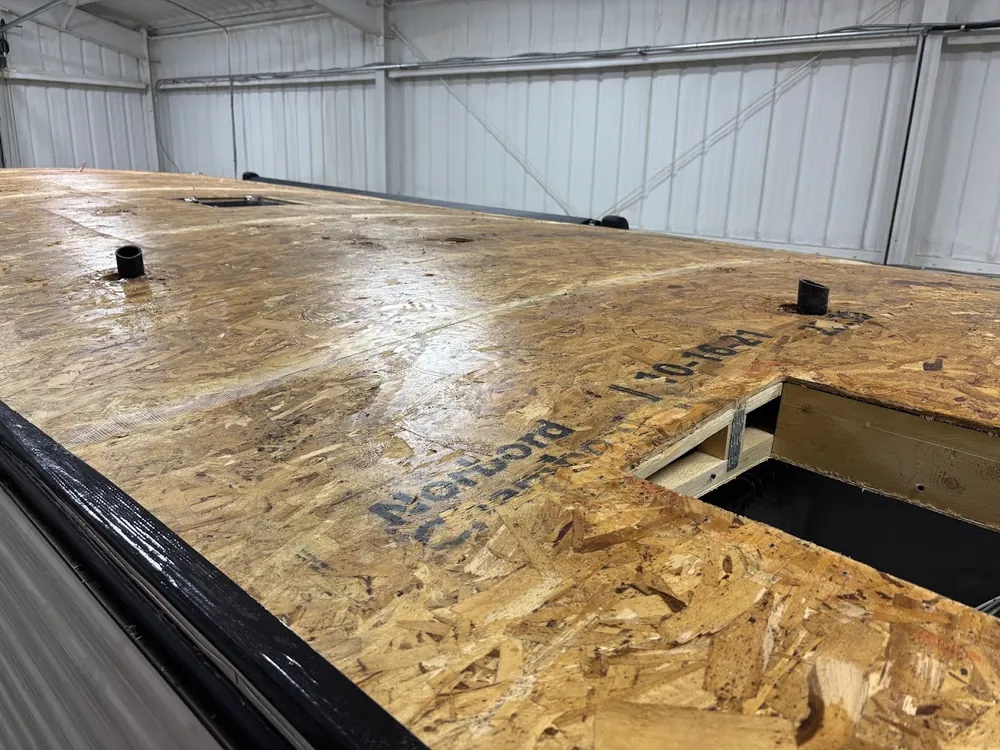
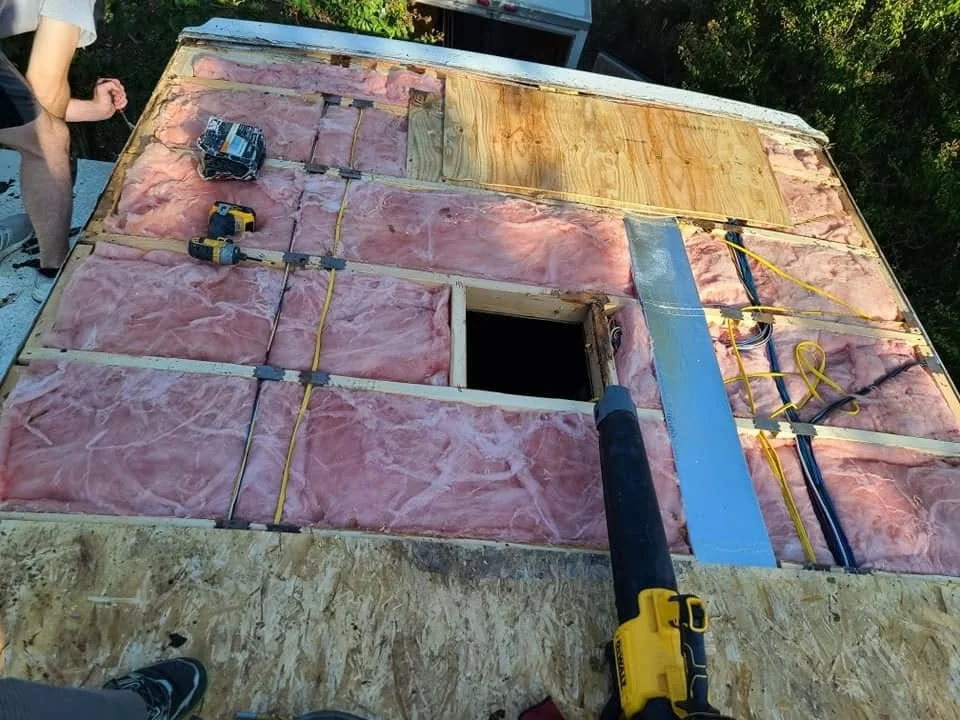
- Know what’s under the membrane. Keystone describes a typical roof as interior paneling, trusses, insulation, plywood or OSB decking and a glued-down membrane. Decking spreads your weight; roofs without it, or with thin, aging decking, may not carry it.
Not sure what kind of roof you have? Our RV roof types guide has a quiz that identifies it.
What’s inside an RV roof, and why it matters
Whether a roof can carry you comes down to what’s under the membrane. Keystone’s manual describes a typical roof from the inside out: interior ceiling paneling, a truss system, insulation, plywood or OSB decking, and a TPO membrane glued to the decking. Jayco and Grand Design both say it’s the decking under the rubber membrane that allows careful walking. The decking spreads your weight across the trusses. The membrane on top is only a waterproof skin; it adds no strength.
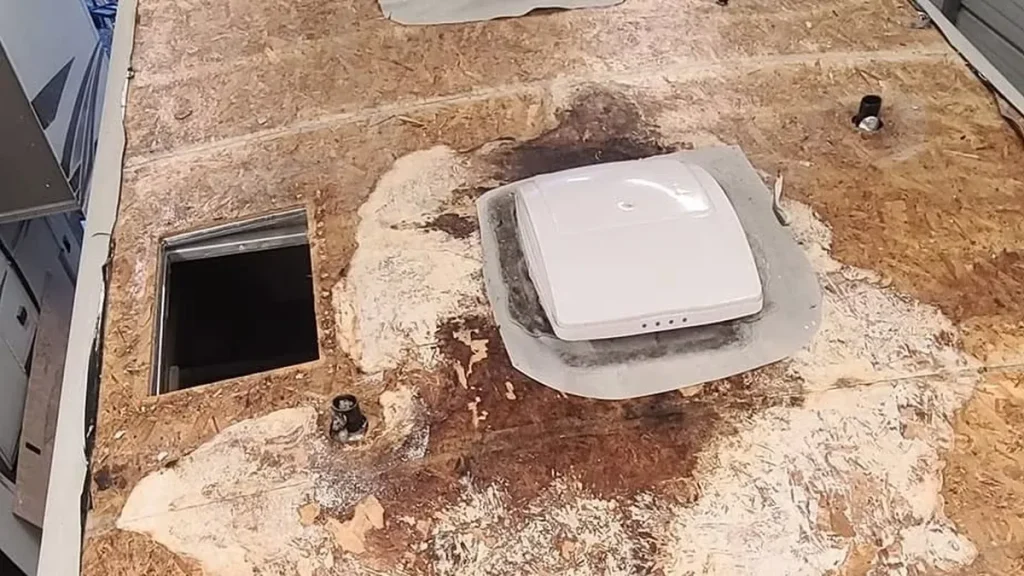
That’s also why a walkable roof can stop being walkable. Water that gets in through failed sealant soaks the decking, and wet plywood or OSB loses strength and eventually rots. A roof that was fine for years can develop a spot that gives way underfoot. Older roofs, roofs with past leaks and any roof with ceiling stains below deserve extra caution, no matter what the manual said when the RV was new.
RV roof walkability checker
Answer a few questions and the checker tells you whether to go up, go up with extra care, or stay off and work from a ladder.
Can I walk on my RV roof? Checker
Your owner’s manual and manufacturer have the final word. This checker applies their published rules to your situation.
Getting up safely: the ladder
Most roof falls start on the ladder or the step from ladder to roof. The manufacturer rules are consistent:
- Know the rating. Keystone’s ladders are rated for 250 pounds, Jayco’s manual says typically 300 pounds, and the Winnebago View’s ladder 225 pounds. Jayco notes the rating includes what you carry.
- One person at a time. Keystone says never more than one person on the ladder at once.
- Face the ladder and use both hands. Keystone says to climb slowly, facing the ladder. Haul tools up in a bucket on a rope instead of carrying them.
- Have a helper hold it. Jayco recommends a second person hold the ladder while you go up and down.
- Don’t use a damaged ladder, and don’t leave anything hanging on it while traveling (Keystone).
If you’re over your RV ladder’s rating with tools in hand, use a separate, properly rated extension ladder or a work platform beside the RV instead.
Using your own extension ladder
If your RV has no ladder, or you’d rather not trust it, a separate extension ladder against the side is the usual way up. OSHA’s ladder rules are written for job sites, not driveways, but they’re a sensible guide:
- Extend it above the roof. OSHA requires a portable ladder used to reach an upper surface to extend at least 3 feet above it, so you have something to hold as you step on and off.
- Set the angle. The foot should sit about one quarter of the ladder’s working length out from the wall.
- Use firm, level ground, or secure the ladder so it can’t shift, and don’t set it on slippery surfaces without securing it.
- Stay within its rated capacity, face the ladder going up and down, and don’t carry anything that throws off your balance.
Rest the top against a solid part of the RV, not a gutter, light or awning rail, and pad it so it doesn’t scuff the finish.
How to move around on an RV roof
- Only when it’s dry. Keystone and Dicor both warn that roofs are slippery when wet. Frost and dew count as wet.
- Wear soft, clean, grippy shoes. Grit on your soles scratches membranes and coatings.
- Stay on the flat, decked area. Keep off curved front and rear caps, gutters and edge trim.
- Never step on fixtures. Vents, skylights, the AC shroud, solar panels and antennas won’t hold you, and a skylight can break through.
- Move slowly and keep your weight low, especially near the edges. Kneel to work instead of bending over.
- Feel for softness. If an area gives underfoot, step back to firm roof and mark it. Soft decking won’t hold you and means water has already got in; see our soft spot guide.
- Spread your weight on older or softer roofs by kneeling on a piece of plywood or a kneeling pad rather than putting all your weight on your knees or toes.
- Don’t carry heavy loads up. Keystone says roofs aren’t designed for coolers or multiple people; the same goes for piles of tools and materials.
Plan around solar panels and roof gear
Roof gear shrinks the space you can safely walk on. Solar panels, satellite domes, antennas, ladder racks, the AC and a row of vents and skylights can leave only a narrow path, and every one of them is something you must not step on. Before you go up, look at the roof from the ladder and plan a route: where you’ll step, where you’ll kneel and how you’ll reach the far side without stepping over anything. If you’re adding solar or other equipment, ask the installer to leave a clear walking lane along one side so future inspections and resealing stay safe. Every mounting foot is also a new set of screw holes in the roof, sealed like any other fixture, so add them to your inspection list. If the roof is too crowded to move around safely, that’s a good reason to have a shop do the maintenance from platforms instead.
When to stay off the roof, even if it’s walkable
- Wet, icy or snowy. Slippery and dangerous. Keystone also warns snow loads over 2 feet or 30 pounds per square foot can damage the roof structure, and Jayco says to remove snow of 8 inches or more and ice of 2 inches or more, taking care not to damage the membrane. Brush snow from a ladder where you can.
- Soft spots, sagging or ceiling stains under the area you’d walk on.
- High wind. Gusts on a high, flat surface throw you off balance.
- Hot afternoons in summer. Membranes and sealant soften, and dark coatings get hot enough to burn.
- Alone, with no one around to hold the ladder or call for help.
- When you’re unsure. Keystone says if there’s any doubt before doing roof maintenance, have your dealer do it.
Roof jobs you can do without walking on it
If your roof isn’t walkable, or you’d rather not, most routine work can be done from the side:
| Job | How to do it from a ladder |
|---|---|
| Inspecting sealant | Move a stepladder or extension ladder along each side; use a phone on a selfie stick for the middle of the roof |
| Washing | Long-handled, soft brush on an extension pole from each side; see our roof cleaner guide for products |
| Putting on a cover | ADCO’s installation guide says its covers don’t require climbing on the roof; see our RV roof cover guide |
| Clearing snow | Soft roof rake from the ground or a ladder |
| Resealing edges | Doable from a ladder for side edges and caps; center fixtures usually need roof access or a shop |
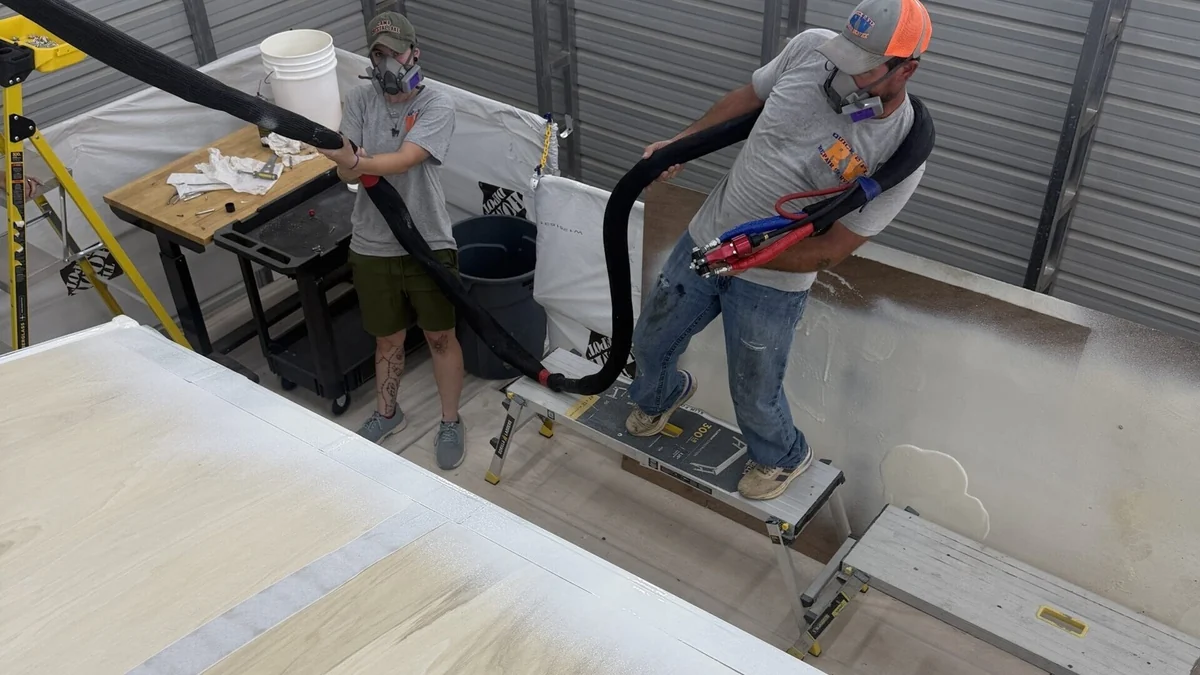
Jobs that need you in the middle of the roof, like resealing a roof vent or the AC, are good ones to hand to a shop if your roof isn’t walkable. Shops typically work from scaffolding or platforms alongside the RV, like the crew in the photo at the top of this page.
How walking damages a roof, and how to avoid it
Even on a walkable roof, feet do damage over time. Grit under a shoe scratches a membrane or coating. Repeated steps in one spot over a weak area of decking can crack sealant or loosen the membrane’s bond. Kneeling on a screw head or a dried bead of sealant can puncture the membrane. And dropped tools dent and tear. Keep traffic to what maintenance requires, sweep before you work, and set tools on a pad or towel rather than on the membrane. If you find damage after a trip up, our RV roof repair guide covers the fixes and EternaBond tape is a common quick patch.
Does the roof surface matter?
| Roof | What to know about walking on it |
|---|---|
| EPDM rubber | Usually over decking. Chalky when aged and slippery when wet. |
| TPO | Usually over decking. Smooth and slippery when wet; Keystone’s manual warns its roofing can be slippery. |
| Fiberglass | Construction varies a lot by maker; check before stepping on it, especially on curved sections. |
| Aluminum | Often on older or vintage RVs; ask the maker or a shop how it’s supported before you walk on it. |
| Coated or sprayed | Depends on the roof underneath and the coating; follow the applicator’s guidance. |
A coating changes the surface, not the structure underneath. If the decking isn’t made to carry a person, a coating won’t change that. Sprayed systems such as ArmorThane’s ArmorSeal 100 AL, SureGrip with a UV topcoat and ArmorFlex UV, described on ArmorThane’s RV roof coatings page, are among the options compared in our coating comparison; ask any applicator how foot traffic affects their product’s warranty.
Buying an RV? Ask about the roof before you need to climb it
If you plan to do your own roof maintenance, check walkability before you buy. Look for the manual or spec sheet statement, a factory ladder and its rating, and ask the seller whether they’ve been on the roof and how it felt. A dealer inspection that includes the roof is worth asking for on any used RV. Our buyer’s roof inspection checklist covers what to look for, and the roof replacement guide explains what’s involved if the decking turns out to be bad.
Make every trip up count
Fewer, better-planned trips onto the roof mean less risk and less wear. Combine jobs: wash, inspect and touch up sealant on one dry, mild day, with a helper on the ground. Follow a set route around the roof so nothing gets missed, and take photos of each fixture to compare next time. Our roof maintenance schedule and reseal interval guide help you plan how often to go up.
Frequently asked questions
Can you walk on an RV roof?
Many RV roofs are walkable for one person doing maintenance, but not all. Keystone says units with factory ladders have walkable roofs, some are walkable without a ladder, and others are neither. Check your owner’s manual or ask the manufacturer.
How do I know if my RV roof is walkable?
Check the owner’s manual roof and ladder sections, the spec sheet for your model year, and whether it has a factory ladder. If the manual is silent, ask the manufacturer with your VIN.
How much weight can an RV roof ladder hold?
It varies: Keystone lists 250 pounds, Jayco’s manual says typically 300 pounds, and the Winnebago View’s ladder is rated for 225 pounds. Jayco notes the rating includes whatever you carry.
Where should I step on an RV roof?
Stay on the flat, decked part of the roof, away from curved caps and edges, and never step on vents, skylights, the AC shroud or solar panels. Test each step for softness and back off anything that gives.
Is it safe to walk on a wet RV roof?
No. Keystone and Dicor both warn that RV roofing is slippery when wet. Wait until it’s completely dry, including dew and frost.
Can I walk on a coated RV roof?
A coating changes the surface, not the structure. If the roof underneath is walkable, a coated roof usually is too, but follow the applicator’s guidance and ask how foot traffic affects the coating warranty.
Sources
- Keystone RV: 2027 Owner’s Manual (walkable roofs, ladders, snow load)
- Jayco: 2027 towable owner’s manual (roof decking, ladder, snow and ice)
- Grand Design: Imagine travel trailer owner’s manual
- Grand Design: Imagine 2500RL spec sheet
- Winnebago: M-Series 2326RK
- Winnebago: View operator’s manual (roof access, ladder)
- Dicor Products: FAQ (wet membranes)
- OSHA: 1926.1053 Ladders
- ADCO: RV cover installation guide
Free quote
Ready to stop resealing?
Get a seamless polyurea roof from a certified applicator near you. Tell us about your rig in about a minute.