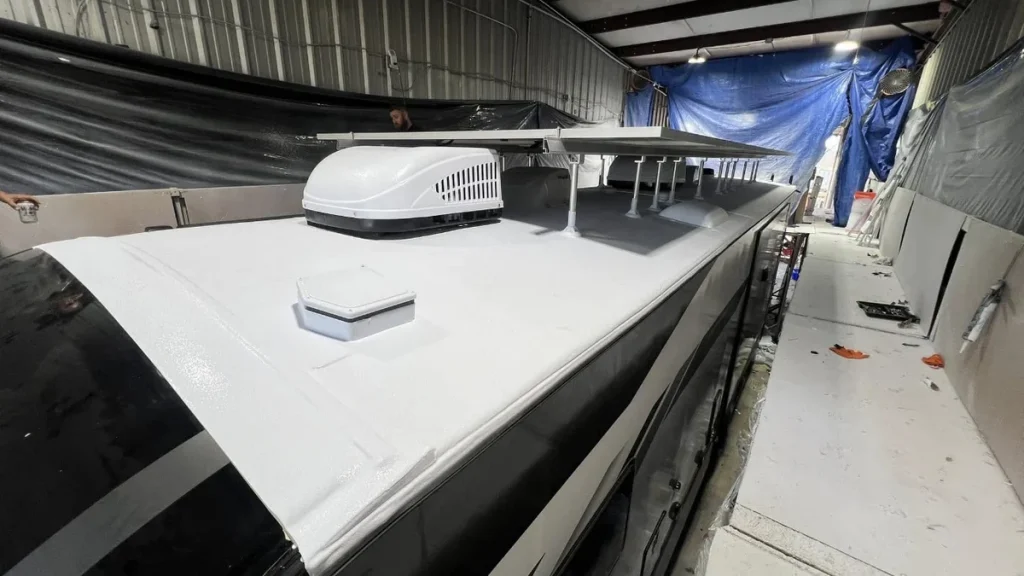
Liquid Rubber vs Silicone vs Polyurea RV Roof Coating
In short
A side-by-side comparison of liquid rubber, silicone, acrylic and spray polyurea RV roof coatings using the makers' own numbers, with a filterable comparison for your roof type.
On this page
For a DIY recoat on a sound RV roof, liquid rubber builds the thickest roll-on film and bonds to the widest range of roofs with the right primer, silicone handles UV and standing water well but locks you into silicone for every future repair, and acrylic is the simplest and lightest option for EPDM. Sprayed polyurea is the professional option: a much thicker, seamless membrane, applied by a trained crew, at a higher price. The right choice depends on your roof type, what’s already on it, whether water ponds, and whether you want to do it yourself.
This guide compares all four side by side using the makers’ own published numbers, includes a filterable comparison you can set to your roof, and covers the warranty traps that catch owners out. For the full how-to of coating a roof, see our RV roof coating guide.
Liquid rubber vs silicone vs acrylic vs polyurea at a glance
| Liquid rubber | Silicone | Acrylic | Spray polyurea | |
|---|---|---|---|---|
| Who applies it | DIY | DIY | DIY | Professional applicator |
| Example coverage | About 50 sq ft per gallon total, 2 to 3 heavy coats (Liquid Rubber) | About 125 sq ft per gallon per coat, 2 coats (Dicor) | About 125 sq ft per gallon per coat, 2 coats (Dicor) | Applied by thickness, often 60 to 80 mils (ArmorThane) |
| Prep | Clean, then the primer made for your roof type | Dicor cleaner/activator on EPDM, TPO primer on TPO | Dicor cleaner/activator | Applicator’s prep and masking |
| Time and weather | Multi-day; final coat cures in 48 to 72 hours | Whole system in one day, 35 to 100 degrees F (Dicor) | Dry weather; sensitive to rain and freezing early on | Sets in seconds; usually done in a shop |
| Future recoats | Can go over most acrylics with its primer | Generally silicone only | Acrylic, or other coatings with the right primer | Per the applicator |
| Example warranty | 10 years, materials only, register within 30 days | 10 years, material only (Dicor) | See the product | Varies by applicator |
Compare coatings for your roof
Set your roof type, roof length, how you want it applied and what matters most. The comparison marks each coating as a good fit, check the label, or not a fit, explains why, and estimates how many gallons each one takes for your roof.
RV roof coating comparison
Figures are from each example product’s published instructions. The label on the product you buy has the final word.
Liquid rubber RV roof coating
“Liquid rubber” is used loosely for several elastomeric roll-on coatings, and it’s also a brand name. We’ll use Liquid Rubber’s RV Roof Coating as the example because its instructions and warranty are published in detail.
How it goes on. Liquid Rubber’s application guide starts with identifying the roof, because the primer depends on it: an EPDM and TPO primer for those membranes, and a multipurpose primer for other surfaces. The roof is cleaned, prepped and primed around vents and edges, the primer dries for about 1 to 2 hours, and the coating goes on in heavy coats over the primer, lap sealant and seam tape. The guide lists about 1 gallon per 50 square feet as final coverage, with 5 gallons for a 30-foot RV as the example, and says the final coat cures in 48 to 72 hours before you drive.
What it bonds to. The company’s FAQ says you can coat over most acrylics and polyurethanes with its multipurpose primer, but silicone-based sealants have to be removed first because they won’t bond.
How long it lasts. Liquid Rubber says most of its full roof applications last 10 or more years depending on climate, usage and application, and recommends inspecting the roof every six months and after severe weather. Its 10-year warranty covers materials only, applies to full roof applications and requires registration within 30 days.
Watch for: the prep step. Liquid Rubber’s guide uses acetone for some prep, with a warning not to pour it directly on the roof. Dicor and Alpha Systems both say not to use acetone on their membranes, so if your roof is still under a roof maker’s warranty, check with them first. Liquid Rubber’s own guide says the same: contact your RV manufacturer to make sure you can work on the roof yourself.
For more on coating rubber roofs in particular, see our RV rubber roof coating guide.
Silicone RV roof coating
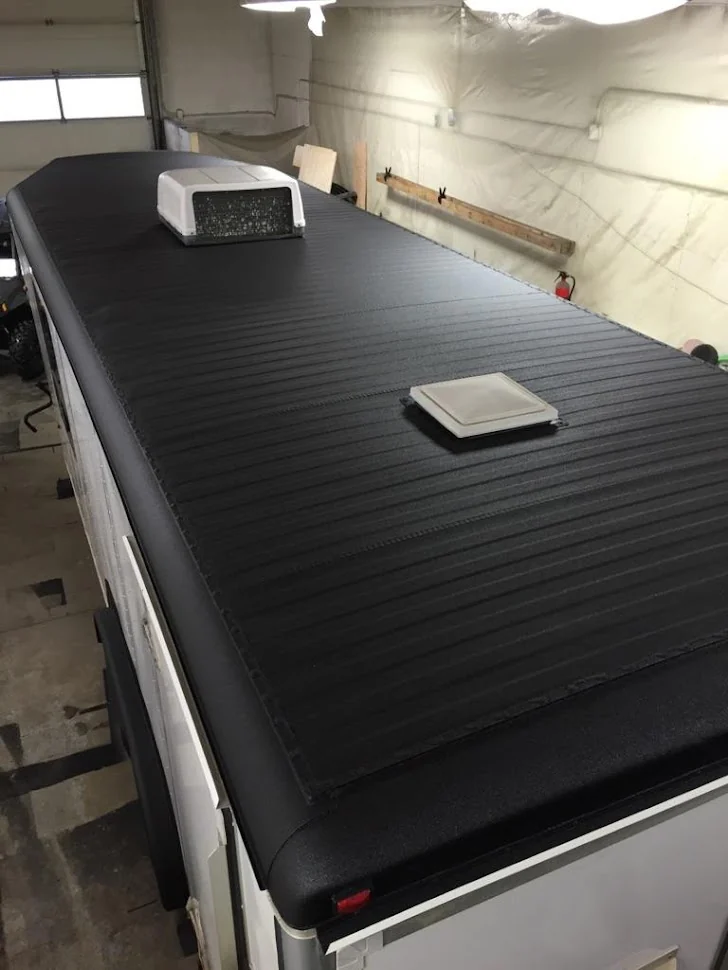
Silicone coatings resist UV well, stay flexible and are generally chosen when water tends to sit on a roof. Dicor’s Signature Extended Life silicone coating is our example.
How it goes on. Dicor rates it for EPDM and TPO. EPDM gets Dicor’s cleaner/activator and TPO gets a TPO primer, followed by at least two coats at about 1 gallon per 125 square feet per coat. Dicor says the full system, priming and both coats, has to be done in one day, with surface and air temperatures between 35 and 100 degrees F and not within 5 degrees of the dew point. That one-day requirement is the biggest practical hurdle for DIY.
The recoat problem. Once silicone is on a roof, very little else will stick to it. Silicone roofs are generally recoated with silicone after a thorough clean and an adhesion test, and Liquid Rubber’s FAQ is blunt that silicone-based sealants won’t bond and have to be removed. Every future sealant and patch on that roof has to be silicone-compatible.
Warranty. Dicor’s silicone coating carries a 10-year material-only limited warranty. Read it before you start: it states that coating an existing roof voids the remainder of the underlying roof’s warranty.
Acrylic RV roof coating
Acrylic is the classic white roof coating: easy to roll, easy to clean up and reflective. Dicor’s acrylic RV roof coating goes on at about 1 gallon per 125 square feet per coat, with two coats, after the roof is treated with Dicor’s cleaner/activator.
Acrylic’s weak spots are weather and water. It needs a dry stretch to cure and is sensitive to rain and freezing in the first days, and acrylics generally aren’t the pick for roofs where water stands; check the label on any product you’re considering. On the plus side, acrylic doesn’t trap you the way silicone does: Liquid Rubber, for example, says it can go over most acrylics with its multipurpose primer.
Spray polyurea
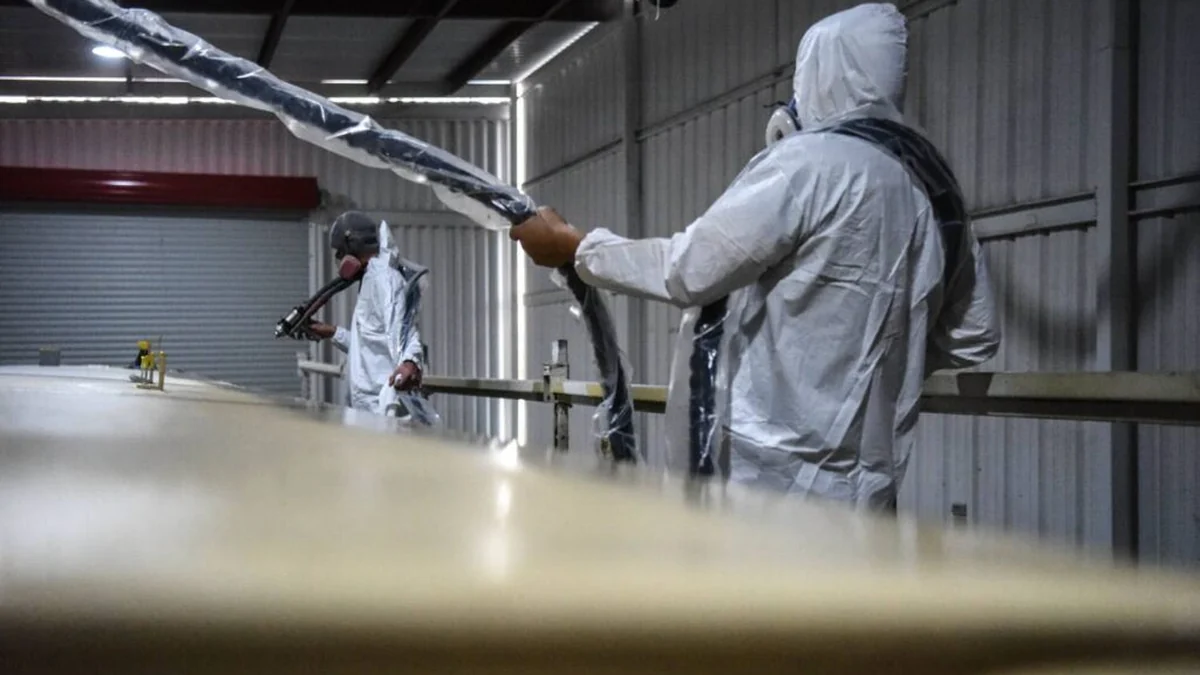
Polyurea is a two-part coating sprayed hot at high pressure through plural-component equipment. It sets in seconds and builds a thick, continuous membrane over the whole roof, seams and fixture flanges included. ArmorThane’s RV roof page describes typical RV builds in the 60 to 80 mil range. Compare that with the roll-on numbers below and you can see why it’s in a different category.
It’s not a DIY product. You hire an applicator, who handles the repair work, prep, masking and spraying, usually in a shop. ArmorThane’s cost guide puts a sprayed polyurea RV roof at roughly 170 to 210 dollars per linear foot. Applicators using ArmorThane products can choose from three RV roof systems: ArmorSeal 100 AL, SureGrip with a UV topcoat, or ArmorFlex UV, described on ArmorThane’s RV roof coatings page. Other polyurea brands and applicators exist too, so compare quotes. You can find an applicator through our directory, and our post on how polyurea works covers the chemistry.
How thick is each coating, really?
Coverage rates hide the most important difference: film thickness. One US gallon spread over 1,604 square feet is one mil (a thousandth of an inch) thick when wet. Divide 1,604 by the coverage rate and you get the wet film per coat.
| Coating and published coverage | Wet film | Total wet film |
|---|---|---|
| Acrylic or silicone, 125 sq ft per gallon per coat, 2 coats (Dicor) | About 12.8 mils per coat | About 25.7 mils |
| Liquid rubber, 50 sq ft per gallon total (Liquid Rubber) | About 32 mils across all coats | About 32 mils |
| Spray polyurea, 60 to 80 mils (ArmorThane) | Applied to thickness | 60 to 80 mils |
Dry thickness is lower for roll-on coatings, because water or solvent leaves as they cure. Common polyurea systems are 100 percent solids, so what’s sprayed is what stays. Our thickness conversion reference has the full math. Stretching any coating beyond its coverage rate is one of the most common reasons it wears through early.
Head to head, factor by factor
Roof compatibility
Liquid rubber has the widest DIY range thanks to its roof-specific primers, covering EPDM, TPO, fiberglass and metal. Dicor’s silicone and acrylic are made for its membranes; for fiberglass and aluminum, look for a product that lists your surface. Polyurea goes over any sound, properly prepared roof. If you don’t know what you have, our RV roof types guide has a quiz.
Ease of DIY
Acrylic is the most forgiving. Silicone is straightforward to roll but has to be finished in a single day in the right temperature range. Liquid rubber takes the most material and the longest overall, spread over more than one day. Polyurea isn’t DIY at all.
Standing water
If your roof has low spots that hold water, silicone and polyurea are the usual choices, and it’s worth fixing the low spot itself if you can. Check any acrylic or elastomeric label for ponding water limits.
Future repairs
This is silicone’s real cost. Everything that touches that roof afterward has to be silicone-compatible. Acrylic and liquid rubber leave more options open.
Warranty
DIY coatings carry material-only warranties: the maker replaces product, not labor. A professional application usually comes with the applicator’s own terms, so get them in writing.
Cost
DIY coatings are mainly a materials cost plus your time. Use the gallon estimates in the comparison tool above and the current price per gallon you find. Sprayed polyurea is priced by the foot and includes labor, prep and masking.
How to estimate a DIY coating job
- Measure the roof. Length times width in feet gives square feet. An 8 by 30 foot roof is 240 square feet.
- Apply the published coverage. At Dicor’s 125 square feet per gallon per coat and two coats, 240 square feet takes about 3.8 gallons, which is why Dicor’s own benchmark for that size is about 4 gallons. At Liquid Rubber’s 50 square feet per gallon total, it takes about 4.8 gallons, in line with its 5-gallon example for a 30-foot RV.
- Add a margin. Fixtures, edges, texture and the odd spill all use extra. Buying a little more than the math beats running short halfway through a coat.
- Add prep products. Cleaner, primer or activator, lap sealant and any seam tape the system calls for.
- Plan the weather. Silicone needs a single suitable day; liquid rubber needs several. Check dew and overnight temperatures, not just rain.
- Plan your exit. Liquid Rubber warns that its EPDM and TPO primer stays tacky when dry and shouldn’t be walked on, so work toward the ladder.
What a professional spray job looks like
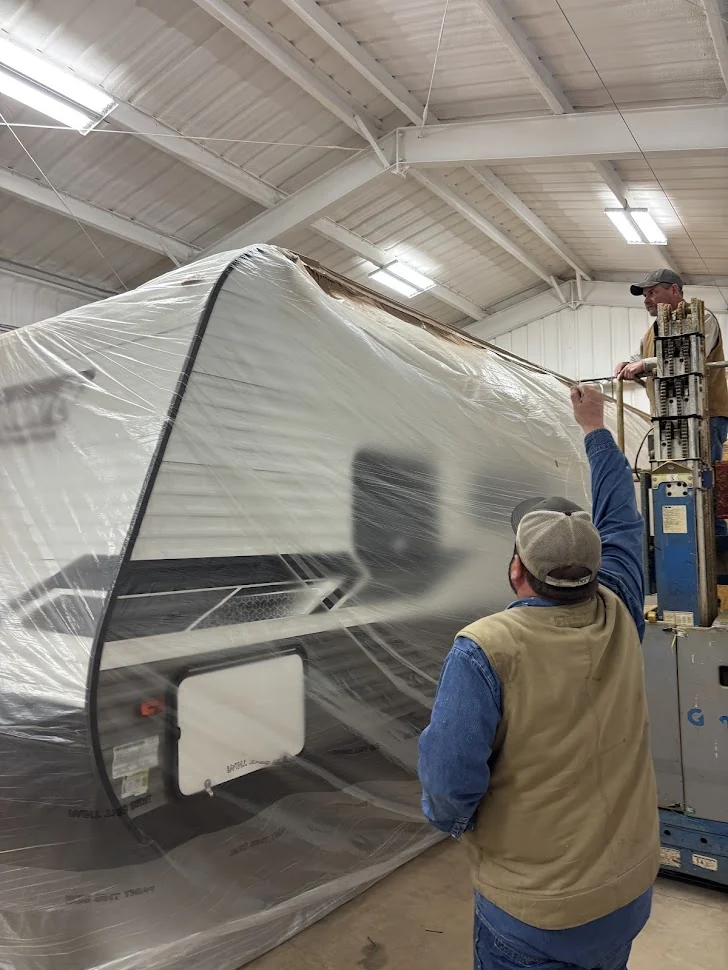
A sprayed roof is as much about the work before the spray as the coating itself. Expect the shop to inspect the roof and decking, repair or replace anything soft, remove or prepare fixtures, clean and prep the surface, and mask the whole coach so overspray never reaches the sidewalls. The coating then goes on in passes to the specified thickness, and fixtures are sealed into the membrane. Ask what thickness they spray, what the warranty covers and for how long, and whether deck repairs are included in the quote. Our post on building an estimate packet helps you compare quotes on equal terms.
Which coating fits your situation?
- Sound EPDM roof, budget DIY, no ponding: acrylic or liquid rubber, with the maker’s prep.
- EPDM or TPO with water that sits after rain: silicone, accepting silicone-only repairs from then on, or polyurea.
- Fiberglass or aluminum: liquid rubber with the right primer, or a coating that specifically lists your surface.
- Roof already coated with silicone: silicone again, or full removal before anything else.
- Tired of maintaining dozens of sealant joints, or want the thickest protection: a professionally sprayed polyurea roof.
- Soft decking, loose membrane or active leaks: none of these yet. Repair first with our RV roof repair guide or leak repair guide, or consider replacement.
Warranty traps to check before you coat
- Your roof maker’s warranty. Dicor’s silicone coating warranty says coating an existing roof voids the rest of the underlying roof warranty. Ask your roof maker before you coat a roof that’s still covered.
- Prep products. Some coating prep uses solvents your roof maker prohibits; Dicor and Alpha Systems say no acetone on their membranes.
- Registration deadlines. Liquid Rubber requires warranty registration within 30 days.
- Full vs partial. Liquid Rubber’s warranty applies to full roof applications, not patches.
- Labor. Material-only warranties don’t pay anyone to redo the work.
Prep matters more than the product
Every coating on this list fails the same way when prep is rushed: it peels off a chalky, dirty or damp surface. Clean with a cleaner your roof and coating makers both approve (our RV roof cleaner guide has a compatibility checker), let the roof dry completely, repair anything soft or loose, reseal fixtures with a compatible sealant, and use exactly the primer the coating maker specifies. Then keep it up: our roof maintenance schedule includes coating inspections.
For honest lifespan expectations by product type, see how long RV roof coatings last.
Whatever you choose, the deck under it has to be sound; see our guide to RV roof soft spots. Coated roofs still need fixture checks, covered in our guides to RV roof vents and how often to reseal an RV roof.
Frequently asked questions
Is liquid rubber or silicone better for an RV roof?
It depends on the roof. Liquid rubber builds a thicker film per the makers’ coverage figures and works on more surfaces with the right primer, but takes longer to apply. Silicone suits roofs where water stands and handles UV well, but afterward only silicone-compatible products will bond to it.
How long does liquid rubber last on an RV roof?
Liquid Rubber says most of its full roof applications last 10 or more years depending on climate, usage and application. It carries a 10-year materials-only warranty for full roof applications registered within 30 days.
Can you put liquid rubber over silicone?
No. Liquid Rubber’s FAQ says silicone-based products have to be removed first because they won’t bond. Silicone roofs are generally recoated with silicone.
How much liquid rubber do I need for my RV roof?
Liquid Rubber lists about 1 gallon per 50 square feet as final coverage, and gives 5 gallons for a 30-foot RV as an example. Measure your roof’s length and width to work out your own figure.
Is polyurea better than liquid rubber for an RV roof?
Polyurea is a different category: a professionally sprayed, fast-setting membrane, often 60 to 80 mils thick on RV roofs, compared with roughly 32 mils wet total for liquid rubber at its published coverage. It costs more and isn’t DIY.
Does coating my RV roof void the warranty?
It can. Dicor’s silicone coating warranty states that coating an existing roof voids the remainder of the underlying roof warranty. Check with your roof maker before coating a roof that’s still covered.
Sources
- Liquid Rubber: RV Roof Coating Application Guide (primers, coverage, cure, lifespan, inspections)
- Liquid Rubber: RV roof coating FAQ (silicone, coating over acrylics)
- Liquid Rubber: Warranty
- Dicor Products: Signature Extended Life silicone coating
- Dicor: Silicone coating 10-year material-only limited warranty
- Dicor Products: FAQ (acetone)
- ArmorThane: RV roof replacement cost (sprayed polyurea pricing)
Free quote
Ready to stop resealing?
Get a seamless polyurea roof from a certified applicator near you. Tell us about your rig in about a minute.